Home AI Solutions Ready-made Solutions Peers & Simulation RAG & Retrieval Use Cases Frameworks Blog Deutsch Contact Us

Engineering notes

Understand AI. Support decisions with evidence.

Every article starts with a practical question, explains the necessary terminology, and links to primary sources. We separate external evidence, project experience, and conclusions — and state what cannot be inferred from them.

Source
External figures, legal status, and product facts link to the primary source.
Practice observation
Our measurements apply to the case described — not automatically to every context.
Limit
We state which conclusion the evidence supports and which it does not.

Llama 2: What Open Weights Mean for Enterprises

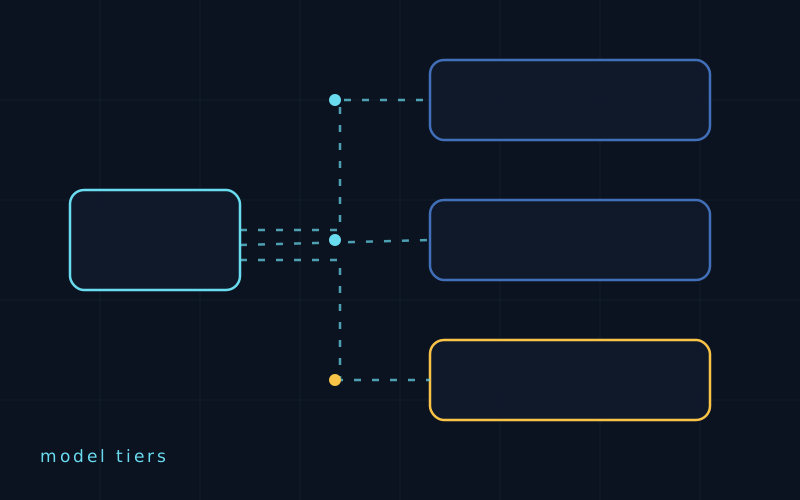
Meta released Llama 2 on July 18, 2023, under a license that permits commercial use. The article examines what open weights change for enterprise architectures: data residency without third-country transfers, fixed-cost inference instead of per-token billing, the measured quality gap to GPT-4, and where the 7B, 13B, and 70B models fit today.
Alignment Is Not a Security Boundary

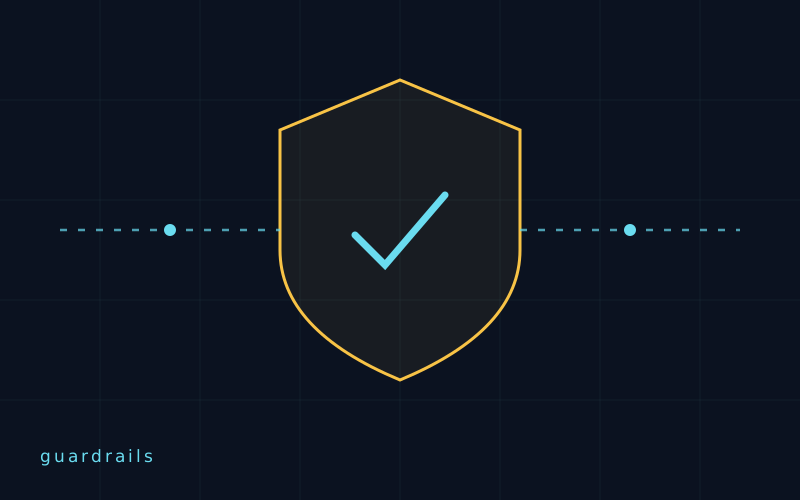
A customer wanted the model's refusal to be the safeguard. We declined and put the permission check outside the model, where it cannot be argued with. What automatically generated adversarial suffixes changed about how we scope agent tooling, and the one question we ask of every agent design.

RAG vs Fine-Tuning for Company Knowledge

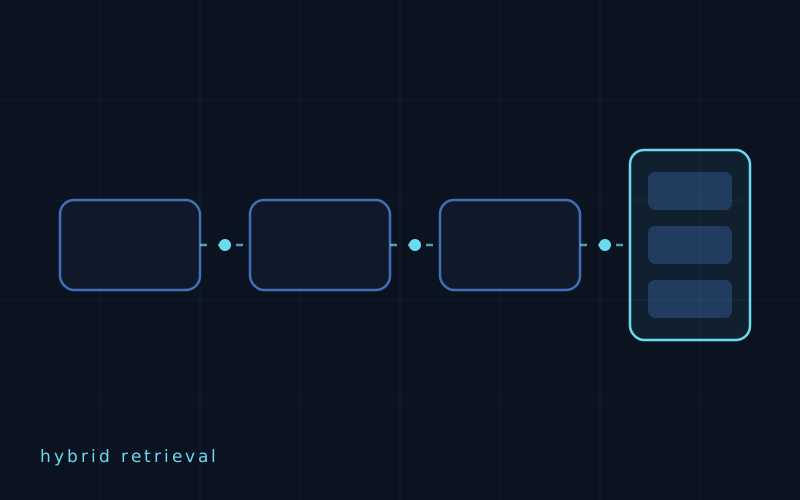
For company knowledge, teams face a practical choice: retrieval-augmented generation or fine-tuning? A mid-2023 engineering view. We explain what fine-tuning actually changes, how embeddings and vector search work, why retrieval should be the default for facts, and where fine-tuning earns its cost — grounded in Lewis et al. (2020) and current tooling.

Why We Cap Context Instead of Filling It

We handed a customer system 40 passages because they fit in the window, and got worse answers than with twelve. What the position effect measured by Liu et al. cost us, the three changes we made because of it, and the one case where we still hand over everything.

Function Calling: From Free Text to Structured Tool Use

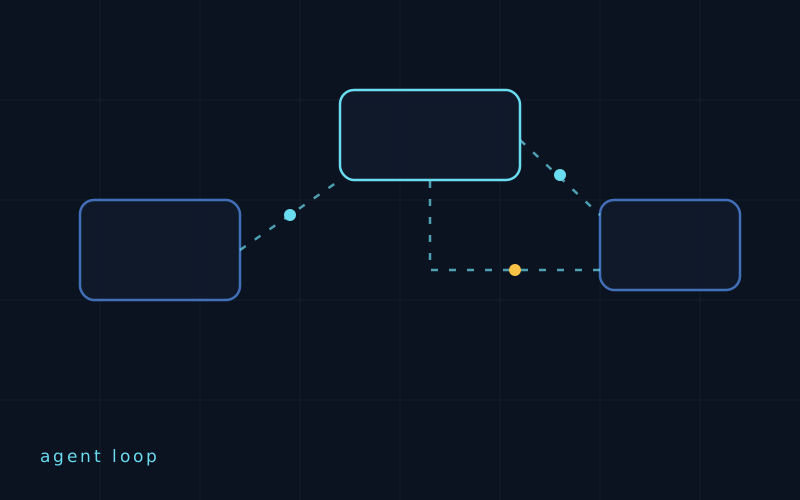
Function calling arrived in GPT-4 and GPT-3.5 on 13 June 2023. We explain what the new functions parameter enables — tool use, structured extraction, first agent loops — how the call cycle works, and where it fails: hallucinated arguments, unenforced schemas, prompt injection. With validation patterns that hold up in production.