Home AI Solutions Ready-made Solutions Peers & Simulation RAG & Retrieval Use Cases Frameworks Blog Deutsch Contact Us

Engineering notes

Understand AI. Support decisions with evidence.

Every article starts with a practical question, explains the necessary terminology, and links to primary sources. We separate external evidence, project experience, and conclusions — and state what cannot be inferred from them.

Source
External figures, legal status, and product facts link to the primary source.
Practice observation
Our measurements apply to the case described — not automatically to every context.
Limit
We state which conclusion the evidence supports and which it does not.

MCP and A2A — The Protocol Layer of the Agent Ecosystem

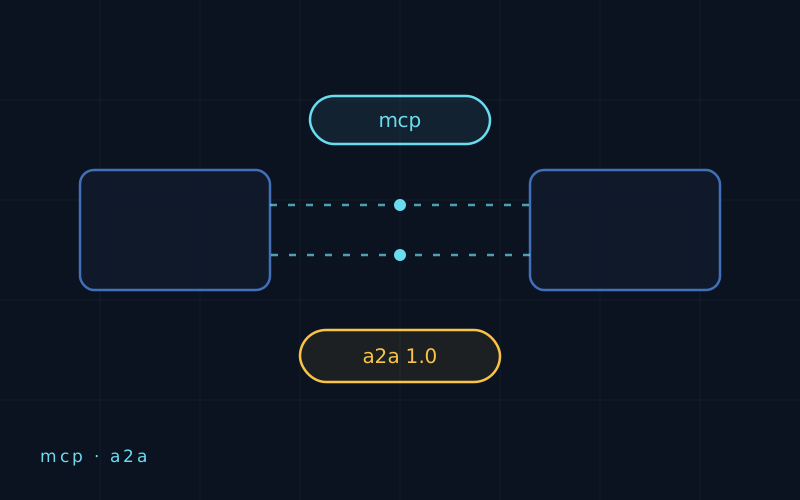
The 2026-07-28 MCP revision makes the protocol stateless and hardens OAuth; A2A 1.0 brings signed Agent Cards, multi-tenancy, and three protocol bindings. This article verifies the current state of both standards, explains how the agent-to-tool and agent-to-agent layers complement each other, outlines enterprise gateway patterns, and states precisely what the protocols do not solve: semantics and trust in content.
Three Years of Notes, One Sentence

Reading back through everything published here, the same finding appears under a dozen headings: a constraint that lives in a prompt or a document is not a constraint. Besanson argues governance belongs in the architecture rather than attached to prompts and documentation. The eight places we learned it, the two where the architectural version was not available, and what the sentence does not cover.

Subagents vs. Peer Agents — Two Working Modes of Multi-Agent Systems

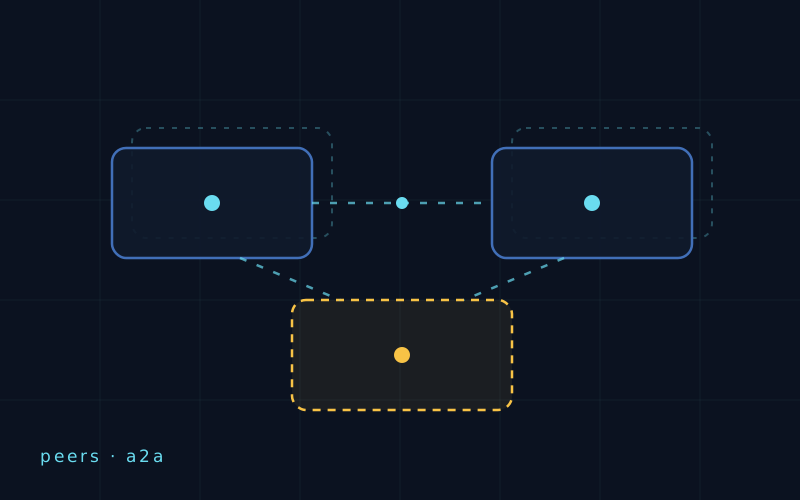
Subagent and peer-agent architectures are both described as multi-agent systems, yet differ in state, lifecycle, cost, and trust model. This article separates the two working modes with verified numbers from Anthropic and Cognition, explains what A2A 1.0 standardizes — Agent Cards, tasks, contextId — shows why independence enables simulating counterpart systems, and gives six decision rules for choosing the right mode.

What Our Coding Agent Costs Per Accepted Change

A year of numbers on the agent that fixes failing tests. Tokens are the small half; review time on accepted and rejected proposals alike is the number that decides it, and rejected proposals still cost a review. Peng et al. compare cloud and on-premise inference economics for coding agents. What we measure, what changed when we measured it, and the threshold below which we would switch it off.

Simulation-First Agent Engineering

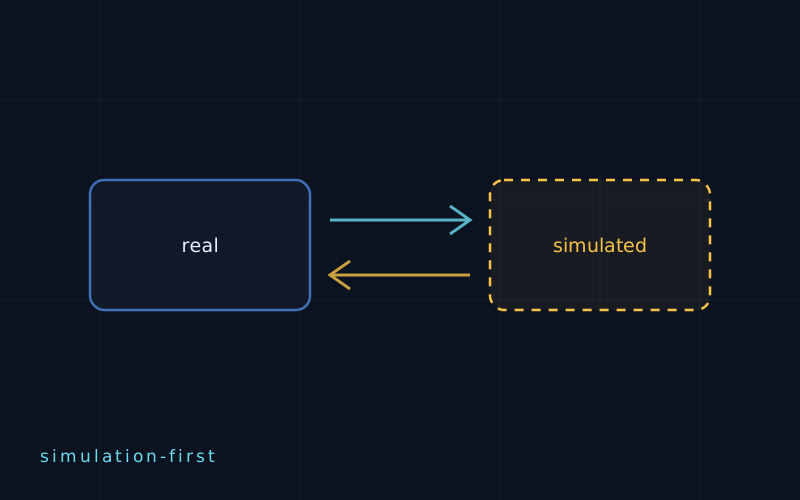
End-to-end agent journeys ultimately trigger state changes in government systems, ERPs, and partner APIs — systems you cannot freely test against. This article defines the simulation-first pattern: swap the real counterpart for a stateful simulated one behind the same contract. We position it against service virtualization and digital twins, cover honest labeling, load and adversarial testing, the fidelity gap, and where simulated counterpart ecosystems are heading.

The First Meeting Is Mostly About Expectations

Two customers, essentially the same system, one renewed and one abandoned with everything working. The divergence was in the kick-off notes: one had written down what the assistant would not do, and the other had written down what it would. Vishwarupe et al. treat expectation management as a design concern. The four sentences we now insist on before any build starts.

Eval-Driven Development for LLM Systems

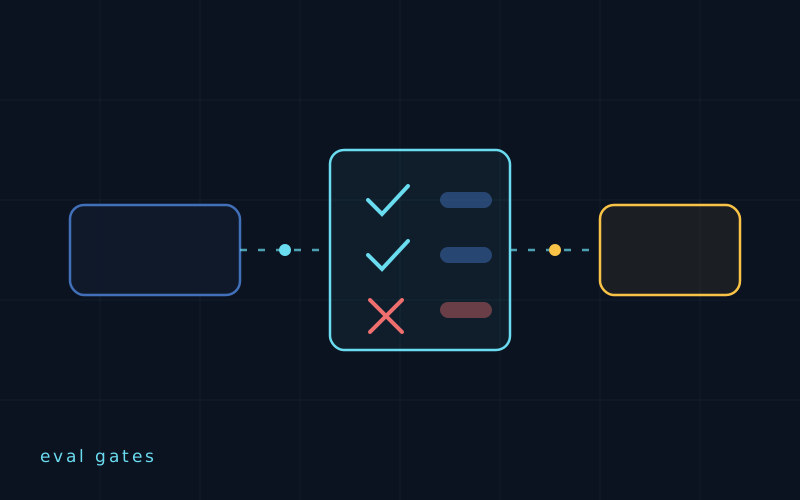
A demo shows an LLM system can work once; evals show it works reliably. This article defines golden test sets, the four standard RAGAS metrics for RAG pipelines, LLM-as-judge with its documented biases and verified mitigations, offline versus online evaluation, and CI regression gates — plus trajectory and tool-call evaluation for agents, with numbers from MT-Bench, τ-bench, and the Berkeley Function-Calling Leaderboard.

One Terminal, Many People, One Memory

Memory improved the assistant for individual users and quietly degraded the shared terminal, where one shift's preference shaped answers for the next. Al-Ratrout et al. name persona confusion in multi-user dialogue. Why identifying the speaker is the wrong first move, what a session boundary should be, and the preference that is safe to keep across everyone.

Asking With Gloves On

The device assistant was used far less than expected, and the reason was that answering a question meant putting down a tool. Voice fixes that and adds a failure text never had: a misheard part number produces a confident answer about a different component. Pahwa et al. benchmark speech tool use. What we confirm before acting, and why the answer is spoken and shown.

GraphRAG — When Knowledge Graphs Pay Off

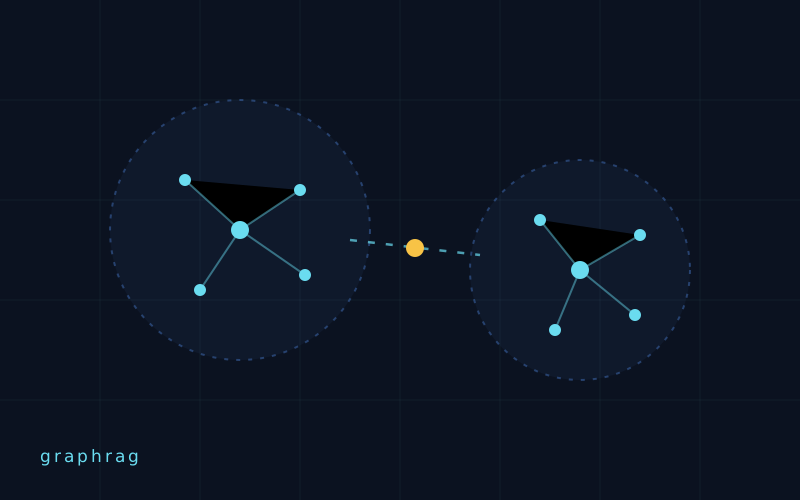
GraphRAG builds an LLM-extracted knowledge graph from a document corpus, with Leiden communities and pre-written summaries, so corpus-wide questions become answerable. We check the verified numbers — 70–80% comprehensiveness win rates, LazyGraphRAG's 0.1% indexing cost and 700x cheaper global queries — and name the cases where plain hybrid RAG stays cheaper, faster, and more accurate. With five decision rules for production use.

Retrieved Correctly, Quoted Faithfully, Still Wrong

The number in the answer matched the document, and the document had been wrong since 2019. Every check we built asks whether the answer matches the source; none asks whether the source is right. Patil works on detecting manipulated numerical claims in retrieval systems. What we can check across documents, why numbers deserve different treatment from prose, and the part that stays a data quality problem.

Hybrid Retrieval Is the Production Baseline

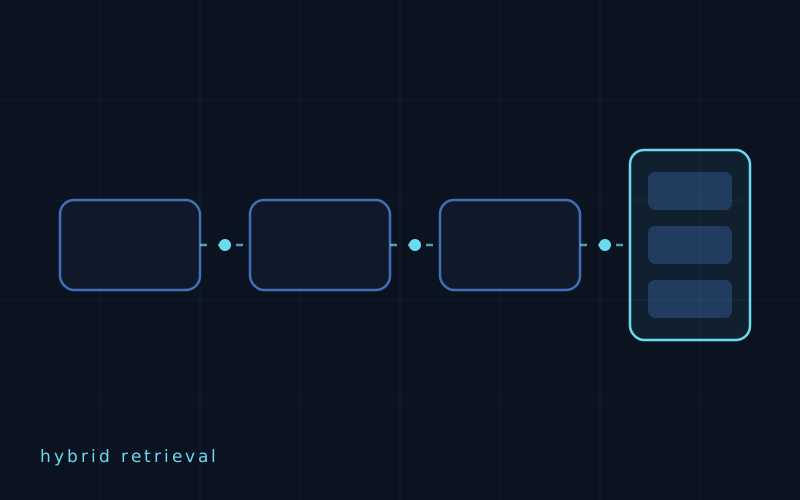
Pure vector search overlooks exact identifiers, error codes, and rare terms. This article defines the production baseline for RAG retrieval: BM25 plus dense embeddings fused with Reciprocal Rank Fusion, followed by cross-encoder reranking. We verify the measured accuracy lifts and latency costs, trace the origin of the '70% of failures' claim, and state clearly when hybrid retrieval is not enough.