Home AI Solutions Ready-made Solutions Peers & Simulation RAG & Retrieval Use Cases Frameworks Blog Deutsch Contact Us

Engineering notes

Understand AI. Support decisions with evidence.

Every article starts with a practical question, explains the necessary terminology, and links to primary sources. We separate external evidence, project experience, and conclusions — and state what cannot be inferred from them.

Source
External figures, legal status, and product facts link to the primary source.
Practice observation
Our measurements apply to the case described — not automatically to every context.
Limit
We state which conclusion the evidence supports and which it does not.

The Assistant That Agreed Too Easily

Told it was wrong, our assistant apologised and produced a different answer. We checked fifty such exchanges: the first answer had been correct in about four out of five. Zhang et al. study whether agents repair when challenged or merely reply. What we changed so a challenge triggers a re-check against the source rather than a new answer, and why the polite version was the dangerous one.
MCP at Enterprise Scale: Registry and Gateways

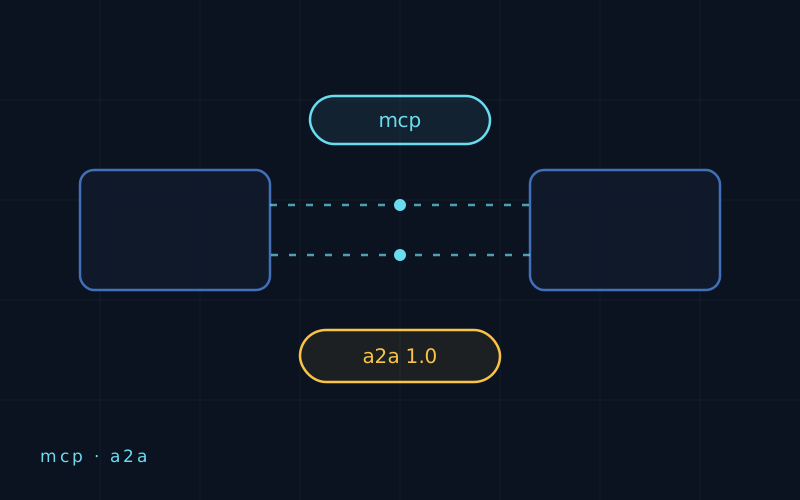
The official MCP Registry made servers discoverable; Streamable HTTP with OAuth 2.1 made them remote. Together they produced a gateway market for centralised authentication, tool-level authorisation and audit. This article covers what the registry guarantees, why the protocol invites interception, which risks a gateway does not close, and what a minimal enterprise rollout looks like.

When the User Changes Their Mind Halfway Through

A user realised ninety seconds in that the filter was wrong and said so. The agent finished the original job correctly and reported success, because nothing in the design allowed a running task to be interrupted. Zou et al. evaluate interruptible agents on long-horizon tasks. Checkpoints between steps, what an interruption costs, and why undo is a different problem we did not solve.

Vector store consolidation: the deployment model decides

In 2026, an ANN benchmark no longer decides the vector store. pgvector 0.8.2 wins where Postgres is already the data platform, Qdrant 1.17 where filtered search and memory efficiency at scale matter, Azure AI Search where a managed Azure estate needs hybrid retrieval and semantic ranking. With memory math, residency and the case for no vector database at all.

An Assistant in Front of the Queue Changes the Arithmetic

The assistant resolved forty percent of requests and misrouted six, and support throughput did not improve. Dada et al. model the gatekeeper who either resolves or refers. A misroute costs a full handling plus the original, so the break-even is not where intuition puts it. What we changed in routing rather than in the model, and the metric that finally made it visible.

EU AI Act Article 50 Now Applies — What to Implement

Article 50 has applied since 2 August 2026. We distinguish provider and deployer duties, explain the limited grace period to 2 December 2026, and turn the Commission's final guidelines and voluntary Code of Practice into a practical checklist.

The Chunker Deserved Its Own Article Three Years Ago

We have called chunking the biggest lever in a dozen posts and never written about it. What we actually do: structure first, one idea per chunk, headings carried into the text, tables never split. Koutsiaris segments by predicted information need, which is the direction we arrived at by accident. Two things we got wrong, and the setting nobody should copy from anyone.

Work IQ: grounding agents in organizational context

Microsoft Work IQ grounds Copilot and agents in how an organization actually works: projects, collaborators, documents, patterns. The article distinguishes a context layer from a data lake and explains why permissions must be resolved at query time, what CVE-2025-32711 revealed about the remaining gap, and which six checks teams should run before adopting.

The Index Knows More Than the User Is Allowed To

One corpus, three departments, and filtering by permission after retrieval. A colleague showed in a morning that the filter could be inferred around: what comes back when a restricted document is the best match tells you something even when the document does not. Tang et al. work on privacy guarantees for retrieval. What we changed, and why per-permission indexes cost more and are the only version we would defend.

Dual-State Architectures for Agents

Chat transcripts record utterances; they are not databases. This article describes a dual-state architecture for AI agents: one authoritative schema-validated process state per instance, with every user-facing view computed as a projection of a specific revision. We cover the pattern's roots in event sourcing and CQRS, its audit and concurrency benefits, and its honest limits.

Who Owns the Assistant After We Leave

We were asked why one assistant had degraded and found eleven across the organisation, with a named owner for two. Acharya proposes a maturity model for managing agent sprawl. The four questions we now ask about every deployed system, the handover document we insist on, and why an assistant nobody owns is worse than no assistant.

Agent Evals in CI: Regression Gates for Trajectories and Tool Calls

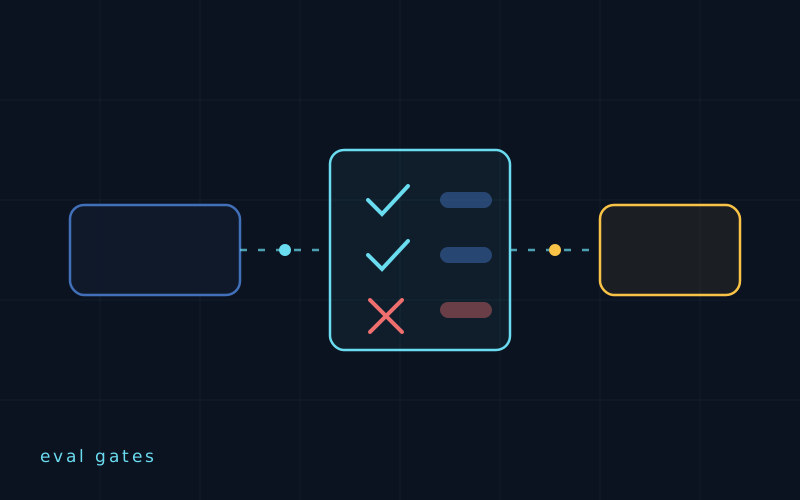
Deterministic tests break down for agents because the same input yields different trajectories. This article shows how to gate regressions in CI in 2026: assertions on tool calls and trajectories, offline datasets with reference outputs, online LLM judges on production traces, cost tracking per run, and eval-driven development as the working method.