Home AI Solutions Ready-made Solutions Peers & Simulation RAG & Retrieval Use Cases Frameworks Blog Deutsch Contact Us

Engineering notes

Understand AI. Support decisions with evidence.

Every article starts with a practical question, explains the necessary terminology, and links to primary sources. We separate external evidence, project experience, and conclusions — and state what cannot be inferred from them.

Source
External figures, legal status, and product facts link to the primary source.
Practice observation
Our measurements apply to the case described — not automatically to every context.
Limit
We state which conclusion the evidence supports and which it does not.

The Batch Job That Ate the Assistant

An overnight ingestion run overlapped with the morning and the assistant took nine seconds instead of two. Park studies how infrastructure faults make autoscalers misallocate resources. Ours was not faulty, it was configured for average load by a team that did not know two workloads shared a pool. What we separated, what we capped, and the alert that would have caught it a month earlier.
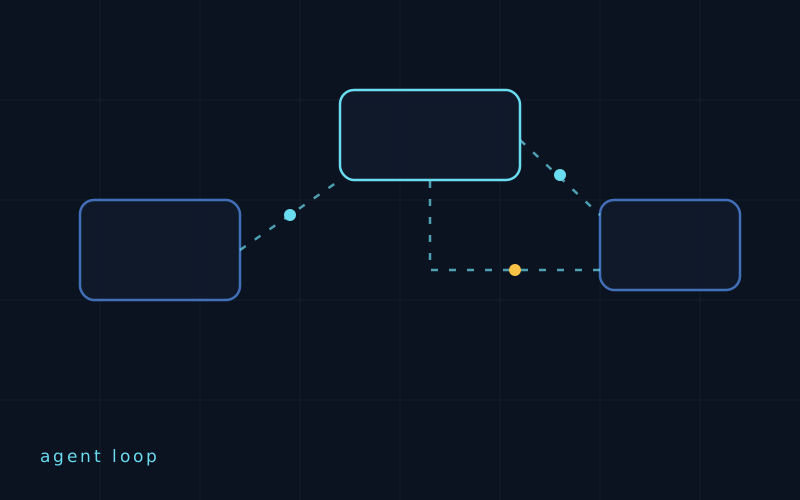
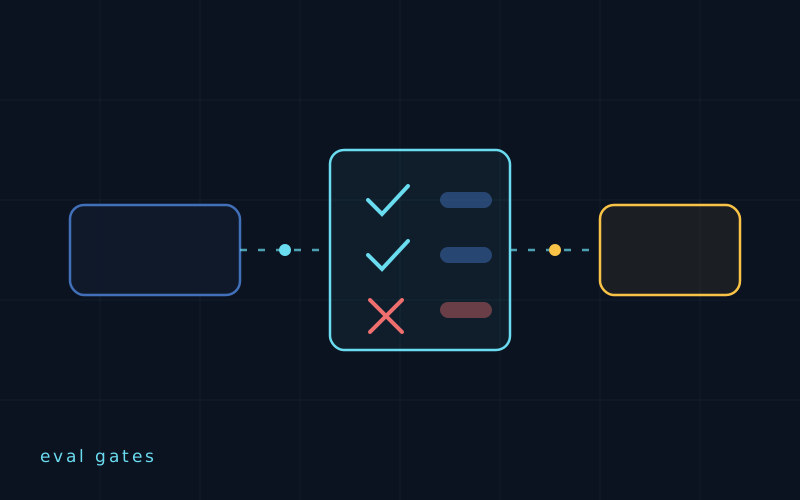
Copilot Studio in 2026: Low-Code Agents Reach Production

Four production-relevant capabilities define Copilot Studio in 2026: model choice including Anthropic's Claude models, computer-use automation in preview, generally available MCP integration, and agent evaluations. We examine what each capability shipped, what remains preview-only, and why low-code agents now clear the bar for production use — with dates, limits, and open questions.

We Do Not Sell a Hallucination Detector

Procurement documents ask for it by name with a target percentage attached. Sinha derives limits on what embedding similarity between an answer and its sources can certify, which matches what we measured: a similarity check catches the copy that drifted and passes the conclusion that does not follow. What we build instead, and the three checks that each catch a different, nameable failure.

Microsoft Agent Framework: The Agent Stack Settles

Microsoft Agent Framework unifies Semantic Kernel and AutoGen in one open-source agent stack for .NET and Python. Both predecessors are in maintenance mode. We summarize the timeline and the API changes, then give a migration playbook and a parity-testing approach that catches behavioral drift before cutover — as of January 2026, with GA expected within months.

Showing More Is Not the Same as Helping

We added sources, confidence, the query and the reasoning to a review screen, and review accuracy went down. Margondai and Mouloua develop a theory of when explanations impair rather than improve decisions through cognitive load. What we removed, the one thing worth showing by default, and why our own principle needed a limit rather than an exception.

Simulated Counterparts: Journey Testing Against Systems You Do Not Control

Agentic systems complete their journeys in systems operated by others: authorities, banks, partner APIs. We define simulated counterparts that implement the identical agent contract, show how end-to-end journey tests run against them before go-live, and argue for strict provenance labeling — a simulated pass proves logic, never production readiness. Verified dates, honest limits included.

A2A Heads for 1.0: What to Build Now

A2A is nearing its first production-ready release. We trace the protocol from Google's April 2025 announcement to the v1.0 Release Candidate: signed Agent Cards, the task lifecycle, multi-tenancy, and the JSON-RPC and gRPC bindings. Plus concrete guidance on what to build on v0.3.0 today and which wire-format changes to isolate before 1.0 lands.

Productivity Numbers Come From Greenfield, Our Work Does Not

A customer asked why our estimate did not reflect a published productivity gain. The study measured new code with no existing constraints; our work is a fifteen-year-old system with undocumented conventions and downstream dependents. Sharma names brownfield as its own category. What actually accelerates in that setting, what does not, and the number we quote instead.

2025 in Review: The Protocol Year

This retrospective examines why 2025 became the protocol year: MCP became the cross-vendor interface for tools, Google donated A2A to the Linux Foundation, DeepSeek-R1 and Apache-2.0 releases commoditized reasoning, and coding agents reached production. We review the verified milestones and outline what 2026 must solve: agent identity, evaluation infrastructure, and simulation.

Peer Agents and Subagents From First Principles

Subagent and peer-agent patterns describe two different architectures, not two names for one. We derive the distinction from first principles — who owns the context, who owns the lifecycle — and show how trust boundaries, token cost, and testability follow, with measured numbers from Anthropic's multi-agent research system and the A2A protocol as of December 2025.

The Protocol Layer Goes Neutral

The Linux Foundation announced the Agentic AI Foundation on December 9, 2025, co-founded by Anthropic, Block and OpenAI. Anthropic donated the Model Context Protocol, Block contributed goose, OpenAI added AGENTS.md. We examine what neutral governance changes for the agentic stack, what it deliberately leaves unsolved, and what engineering teams should do now.

Semantic Kernel and AutoGen Become the Microsoft Agent Framework

Microsoft Agent Framework entered public preview on October 1, 2025, converging Semantic Kernel and AutoGen into one SDK. Both predecessors are now in maintenance mode. We set out the verified facts, map the .NET programming model changes, and outline a migration sequence that avoids maintenance-mode debt before the framework reaches general availability in 2026.